

“Spec in, chip out” is a great demo. Practically a magic trick. But how do we know the spec is right?
The assumption is that a human provides the specification. AI progressively automates everything required to turn it into a chip, reducing engineering costs and time to market. It treats the specification as fixed and the underlying constraints as necessary. An autonomous design system could produce exactly the chip we asked for while leaving substantial economic value on the table.
A chip specification contains years of accumulated assumptions. Some come from physics, some from past products, from organizational boundaries and feedback loops that once took months. We rarely revisit all of them because it is expensive in today’s workflows.
AI makes that reconsideration cheaper.
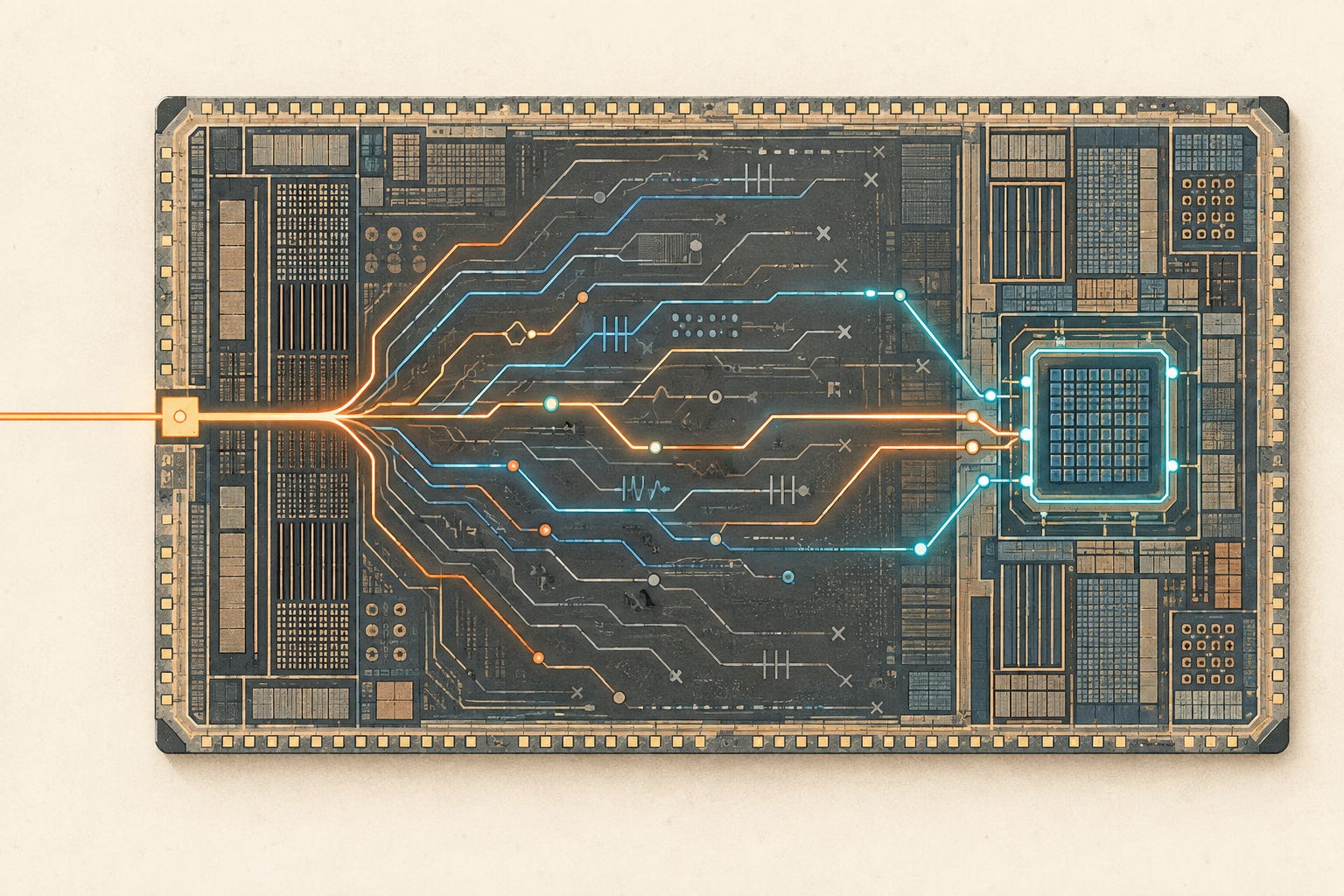
Why we need precaution
Let me back up.
The semiconductor industry was built on guardbands. There is timing margin, voltage margin, area margin, bandwidth margin, thermal margin and many more. These buffers account for variability and leave room for behavior our models may not fully capture.
A single bug can cost hundreds of millions of dollars. Chip designers rely on models and simulations to predict how the chip will behave in the real world. We only find out how close these predictions were to reality when we test silicon. The feedback loop from design decisions to testing physical silicon can take 18 months. Once shipped, chips will be in the wild for years. Under those conditions, engineers add margin.
Similar buffers appear throughout the computing stack. Chip teams protect performance targets. Kernel developers account for hardware variability. Data-center operators add capacity. Inference providers build SLAs around the behavior they can guarantee.
Each team has a reason for its margin. But what is harder to see is how much precaution accumulates across the stack, and which assumptions still hold for a particular workload.
AI gives us a chance to replace some of that precaution with evidence. Faster work inside each existing silo can preserve the assumptions and handoffs between teams. Experiments that cross those boundaries can reveal which margins can be safely reduced.
This requires pushing beyond today’s abstractions. We need to connect the movement of electrons in a device to the kernel, to the workload, to the product experience and the business outcome.
An observation from a debug workflow
On the semiconductor team I lead, debug offers the clearest example. Some debug flows are now fully automated. Work that took days now takes minutes.
But hours saved didn’t directly translate to better chips or faster design cycles. Managers could not yet plan additional work around time savings from an unproven system without risking an already demanding chip schedule. So engineers found other ways to make use of their freed-up time. They questioned upstream design decisions, including bandwidth assumptions and voltage-frequency constraints. Earlier this year, I wrote about potential performance gains from such ambitious explorations.
As optimization decisions became cheaper to revisit, engineers explored more. They also invested more deeply in evaluations that reveal where AI works, where it fails, and when it should escalate to a human. These evaluations help determine how far a single engineer can push chip performance.
I believe this behavior will become systematic: teams will use cheaper experiments to distinguish necessary margin from inherited precaution. Whether that translates into better silicon remains to be demonstrated.
Every chip designer becomes an “evidence engineer”
In February, I wrote that every chip designer will become a generalist.
The common prediction says that every engineer will effectively become an architect. Humans will define intent while AI handles implementation. I don’t buy the architect framing because it still assumes today’s siloed setup.
I still believe chip designers will eventually become domain generalists. But my prediction has become more specific: every chip designer will become an evidence engineer, someone who runs experiments to decide which constraints still matter.
This role will span the design lifecycle. Engineers will run experiments and decide which optimizations matter. They will verify the design, the specification and the AI itself.
Did the proposed change work across the relevant corners?
Does the original constraint still matter?
Has the AI earned trust in this region of the design space?
When should it refuse or escalate?
These questions require an understanding of devices, workloads and user experience. Engineers will need to move down to physics and up to business outcomes.
The right chip may offer just enough flexibility for a specific business model. Hardware designed to optimize the flow of packages through a distribution center may not need the margin required to train gigantic models for cancer diagnosis.
What remains after the experiment
Each experiment leaves behind more than a result. It captures the attempted intervention, the relevant constraints and the conditions under which the conclusion holds. Over time, this becomes a map between device-level decisions and product outcomes.
The evidence created through experimentation remains specific to the company, its products and its workloads. Each deployment and round of expert feedback spins the flywheel and can make that accumulated knowledge harder to replicate.
What would tell us this is working
My earlier AI-verification model had five dimensions: contract, semantics, coverage, limits and the learning loop. I would add a sixth:
Exploration quality: Did the experiment produce credible evidence that changed a consequential design decision?
A retained optimization counts. A rejected hypothesis also counts when the evidence closes a promising path. Retention rate alone rewards timid exploration.
At the individual engineer level, I would measure verified learning: how effectively an engineer turns plausible hypotheses into evidence that changes a design decision.
At the company level, I would measure validated guardband reduction: how much customer-facing specification margin the company compresses relative to the previous generation without moving risk elsewhere. Only the company can measure that well. This makes it a potential source of durable differentiation.
I have moved on from using time saved and schedule compression as the primary measures of AI impact. I wrote earlier about the difference between saving time and making previously infeasible work possible. The past few months have strengthened my conviction.
“Spec in, chip out” will happen. It will produce compelling demos and useful products. However, the larger economic opportunity appears when cheap feedback reaches back into the specification and replaces inherited precaution with evidence.